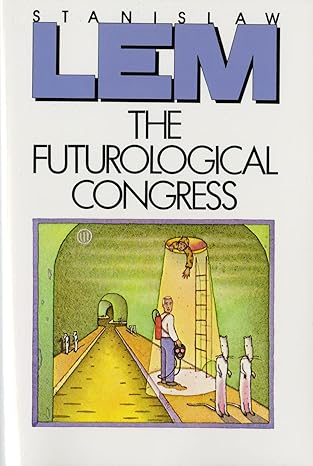
This mind-bending work of satirical science fiction explores the question of whether there is a meaningful difference between objective reality and perceived reality. In the novel’s dystopian world, governments deploy psychotropic drugs called mascons (short for “masking compounds”) used to manipulate perception and create illusory realities, concealing the “true” reality of overpopulation, resource scarcity, and societal collapse. Which begs the question: which reality is “real”? Does it matter? Do you believe that our reality is merely a construct of the mind shaped by our senses, biology, psychology, and experiences (as advocated by Immanuel Kant in his Critique of Pure Reason)?
At some point the main character finds himself in a version of reality where virtually every aspect of perceived reality is induced by a specific drug designed to induce a specific hallucination.
Some of the most interesting mascons from the book:
- Recriminol: Makes users more prone to recrimination by boosting combative, argumentative behavior.
- LTN (Love Thy Neighbor) Bomb: Forces unconditional love. While compulsory, this new-found love isn’t necessarily rooted in genuine feelings of devotion and affection often leading to extreme social behavior and chaos.
- Duetine: Splits consciousness into two interacting parts allowing users to discuss topics with themselves.
- Authentium: This ironically named agent creates synthetic memories of something that didn’t actually occur.
- Caucasium: Makes users appear to be Caucasian.
- Gospel-credendium: Causes religious, faith-based devotion to nearby objects, leading to worship. Amusingly, this extends to inanimate objects like a napkin or spoon!
Of course there is also an anti-mascon drug:
- Up’n’at’m: A countersomniac and antipsychem agent that reveals true, harsh reality by countering the pleasant hallucinations induced by mascons. This is similar to taking the red pill to see the reality that is obscured by The Matrix.
So which is better, a happy illusion or a despair-filled reality?